

-
Announcement
-

Simtropolis Returns! 05/26/2026
See here for details about our site recovery efforts.
-
Search the Community
Showing results for tags 'newcity'.
Found 41 results
-
For those who do not know New City was a city builder under development by Lone Pine Games LLC. The game after a few updates was abandoned and after a few have the developers released the source code of the game. Happy viewing and programming! Steam https://store.steampowered.com/app/1067860/NewCity/ Github https://github.com/LonePineGames/newcity-public
- 1 Reply
-
- 5
-

-

-

-
- newcity
- source code
- (and 2 more)
-
Hey there everybody. I am a long time city-building fan who has kind of lost interest over the last few years. Skylines was fun for me to a certain extent, but didn't quite scratch the city-builder key points I was looking for- mainly a density related downtown growth algorithm, a more realistic scale, and more toned down color scheme (less donut trucks if you will). NewCity is more of a Macro city builder, and doesn't focus as much on traffic, sewage, electricity, death care and that type of thing. If you like that stuff, this probably isn't the game for you. If you found emptying cemeteries cumbersome, it might be. It has come a long way in the last year, and I am hoping as more people learn about it, it will really take off and become a cult classic of city building. With more people modding and adding buildings it could really take off. It has a very interesting simulation that a lot of other city-builders haven't figured out with a city-center effect. It is also strange to me that it has received such little attention in the city builder genre, as it is a lot of fun, and does some things right that others haven't. The game is only $15 on Steam right now.. definitely worth trying out. For me a lot more fun than Skylines, but everyone has their own taste.
-
Hello everyone!! I have exciting news! I have picked up my SC4 playing as of late and have decided to expand my region of New Humboldt. Claxton has been the only major metro in this region, but I am embarking on a new 2nd metro. It will be known as Fairway. It will connect to Claxton via the regions road network. The Humboldt map is HUGE and my main goal is to fill it! I started a metroplex about two years ago ago on this map, some pics are on ST. I have abandoned it and felt the need to start a fresh one on this map. It by far has been my favorite map. So many possibilities. This post does not contain many pics, so sorry. This will be the center of Fairway. And here is a poorly done stitch of the region. The outer rural communities of Claxton can be seen in the far bottom left corner of this shot. This is where Fairway will connect with the Claxton Metro. I have the areas labeled. Check back for updates! --CityNut607
-

Entry Three: A Journey down Fort Wayne/Hayward/Church/Park
MatlockMan posted a City Journal entry in Normanhurst - A NewCity for an old mayor
"First rule in government spending: why build one when you can have two at twice the price?" - S.R. Hadden, Contact (1997) What just happened? As the Mayor's slow train came to a halt in Central station, his mind was still racing. Two billion dollars - no strings attached - to keep building. He'd better use it wisely. ... A new day dawns, and now it's 1956. Normanhurst's population has swelled to nearly 130,000! Aggressive expansion has brought new homes to the region. During the economic downturn, many turned to farming. There was an explosion of new farms in outer regions, but demand has outpaced supply. But with the recession nationally all but over, big business has taken a keen interest in Normanhurst. Congestion is however a-brewin' on the city's major thoroughfare. Named Park Road for most of its route, it's actually four distinct roads that all began separately but were linked up as Normanhurst's population has soared. The mayor's planners can give us a tour. The main road, at this stage called Park Road, cuts right down the middle of Normanhurst's outer industrial areas, starting at an off ramp of a local expressway. Despite being three lanes in each direction, this interchange is frequently packed with commuters and freight trucks. What a nightmare! Upgrades will be needed. The road then continues through industrial parks... ...slipping below Chattanooga Road... ...into suburbia, where it becomes Church Street... ...then into the City, where it becomes Hayward... ...and then finally as Fort Wayne, it crossed the river to meet up with another expressway, the Normanhurst Bypass. Its route through the city is illustrated below: As you can probably tell, the road carries a lot of traffic. It also dissects a number of other busy thoroughfares from across the suburbs, meaning rush-hour is an absolute mad scramble. At Chatanooga Road, the intersection has had to be grade separated to keep traffic flowing, but it has only bought a little time. Further upgrades to the entire route are needed, potentially grade separating it and making it an expressway between Ringroad One and the beginning of Church Street. Town planners think widening the road even further, to the intersection of Fresno/Fontana, would require too many resumptions of neighbouring properties and would effectively split communities in half. What do you think should happen? -
Entry Two: Get to know Normanhurst
MatlockMan posted a City Journal entry in Normanhurst - A NewCity for an old mayor
"The locals have dubbed the popular spot "Burger Boulevard," after a number of fast-food franchisees all purchased lots along the busy Park Road." - NORMANHURST COURIER, 1954 We'll have an update on the Mayor's journey interstate shortly, but first, let's take a look at how Normanhurst is developing. By 1954, local traffic along major thoroughfares had reached such levels that it necessitated the entire city (now close to 50,000 residents) to be encircled by a grade-separated ring road. Development is now beginning to take off on the western and northern shores of the river, while industrial zones are developing further from the banks. In the city, the newly-established local paper has reported that residents have dubbed small neighbourhoods nestled around Central Station after prominent local families like the Chilcotts and the Belmonts. These small enclaves are becoming dense little communities. Meanwhile, development in the CBD remains slow; there isn't yet demand for development of larger offices. In coming years, new plazas and parks will hopefully drive up property values. A view of the city at night: Transport view. South of the city, the newly-minted suburb of Warwick Farm still has half of its original farms... for now. It's slowly being eaten up by the seemingly-unstoppable growth of Normanhurst's suburbs and industrial zones. Overall, Normanhurst is coming along well. Attention is going to turn toward suburbs north and west of the river for a little while hereon. -
Entry One: A rough start
MatlockMan posted a City Journal entry in Normanhurst - A NewCity for an old mayor
"Every day is a crossroads." "Friday APRIL 4TH 1952 - BRISBANE: STOCKS have suffered their fifth straight day of losses as concerns mount about a run on the banks. It comes after disastrous nationwide employment statistics, which showed four million workers have now lost work since the recession began. MPs met late last night to discuss potential stimulus measures after leading bank CNBA warned withdrawals had hit 20-year highs." - NATIONAL NEWSWIRE Was this the end of the mayor's journey? Had his big move been all in vain? Indeed, the economy had been in much better shape back before millions were spent widening Normanhurst's main road, building a new city centre and rail terminus. It had a very different city just mere months ago, the mayor thought. His mind turned back to that fateful journey... TWO YEARS PRIOR, and lush vast wilderness rushed past the mayor's second class carriage window. The steam train was in a hurry as it wound through the mountains. It was making up for lost time after a longer-than-anticipated stop at Cathedral City. The mayor heard it had something to do with the unions. Here we go, only something like 20 minutes until I arrive at my new home, he thought, looking out the window. The train was navigating along excellent track, steaming with purpose now as it closed in on Normanhurst. The locomotive was only a twice-daily service, and one had to request it stop at Normanhurst, so small was the town. The conductor had given a look of confusion when the mayor asked that a halt be made at the town. Finally, the whine of the brakes and the slowing of the huff-huff signalled that the train was arriving. As the mayor walked out of the small station, what greeted him was a tiny town, not more than five blocks of homes. And then some farms lay to the east and west. Even then, Hawaii Road - the town's main street leading off the local highway, on which the the town's two shops were found - had been a problem. Rammed with cars and trucks, bumper to bumper. The traffic surprised the mayor, for he reckoned there could be only a couple thousand people in this township. Even if one included the far-flung farming villages, the number of cars was surprising. The mayor never got to the bottom of why Hawaii had become a traffic sewer, but it was his first edict as mayor to widen it. Even four lanes wouldn't do; three in each direction it was. After years leading a big city, where money flowed without end, the mayor wasn't probably aware of the cost. But the Feds were willing to fund it anyway - no politician wanted to roadblock the mayor's first project. After all, a journalist from Toombul had even been dispatched to the budding town to follow the mayor's first few months in office. She would report back to residents of his former city his every command, success and failure. Unwittingly, the reporter had become the first of her profession to visit the town (there was no local paper at that time). Months passed, and as stories flowed back to Toombul, a theme of the young journalist's scribes was that remarkably little was changing. She however wasn't privy to the internal planning within Normanhurst's new planning department. The mayor had won millions of dollars in Capitol funding to house an additional 20,000 people by 1952. "The amount should be firstly spent towards a new rail terminal, central business district and housing for the township," read the Federal Government's statement. "A new settlement, north of the river, should then be of upmost consideration." So the mayor set planners to carve up land to the town's north-west corner. Property taxes were dropped to zero and within two years, spurred by the promise of good-paying jobs, 20,000 people had indeed made Normanhurst home. To the mayor, the most remarkable thing was the pace of growth. Two pictures, taken just a month apart, showed how quickly the new central business district had been laid: Now armed with a six-platform rail terminus, trains were now running 20-minutely through Normanhurst, between Cathedral in the south and several townships in the north. A direct service from the west, from Brisbane via Vernon, became the first service to regularly service the new platforms, dubbed Normanhurst Central. The old station, located in the town's east, was now branded 'Old Town.' But then that fateful newspaper dropped on the mayor's doorstep. "RECESSION HITS," the headline blared. Now blocks of the new CBD, which developers had been circling like vultures, were going to sit undeveloped. Metrics from the planning department showed demand for all development - residential, mixed, commercial, office, industry and even farming - had fallen to nought. 1952 had started with vigour, but by April the mayor was desperate to know whether the expensive project of building an entirely new city had been abandoned by a now-contracting economy. Two years after it all began, the mayor found himself on the train heading away from Normanhurst. His destination: the Capitol. -
Hey, Thought I'd make a topic for this game. Who else is playing it? I've been playing SimCity 4 since it came out and have generally unable to find a game that scratches the same itch - both SC2013 and Cities: Skylines had quirks which didn't really feel the same. Anyway, started playing NewCity recently and happy to report I've spent around 40 hours now. Probably about 30 hours have been spent on a single city. I'm really impressed, even if it is a little buggy. So impressed in fact, that I've started a CJ on a new city I'm getting underway. Anyone else keen to share their creations? (And no lol, I'm not employed by LonePine. Just really want this game to get more exposure - I think it's very good).
-
Prologue: A taxpayer-funded drink
MatlockMan posted a City Journal entry in Normanhurst - A NewCity for an old mayor
"A society grows great when old men plant trees in whose shade they know they shall never sit" - Ancient Greek proverb The year is 1950, and the sun is setting on the tall towers of Toombul... and apparently, a career. For weeks, whispers have been creeping through the corridors of power - City Hall, the Business Guild, the various unions. Even the papers, who generally don't lend themselves to unfounded scuttlebutt, have begun dedicating little columns here and there on the talk of the town: The mayor is retiring! Not just any old mayor either, but THE mayor. The man who's led Toombul for 25 years, who unleashed the public servants to help rebuild devastated, flood-ravaged low-lying suburbs, who oversaw the biggest expansion of the once-flailing subway system and connected far-flung satellite cities with glistening expressways. When the mayor took charge, Toombul was bankrupt, crime-riddled, its population on the slide. Now it stood as a beacon - over 800,000 residents and growing by the second - with thousands more in dormitory villages. Whichever neighbourhood one ventured, restaurants would be fully booked and stores would be making a good day's trade. Through some miracle, not to mention careful balancing of the wants of workers and businesses, this man, who stood as a constant amid unending change, had turned the 'Bayside City' into the envy of countless mayors nationwide. It hadn't all been smooth sailing, the mayor thought to himself, staring at the mirror, at the greying, tired man. It was two minutes to 6pm - he'd promised the reporters he'd face them at the top of the hour. They certainly didn't help much... and what's worse, they probably think I'm headed to a home... all this speculation, weeks and weeks. He buried his face in his hands for a moment, then faced the mirror once more. No, the ageing mayor still had one last trick up his sleeve. The rumours were half-true, as he was indeed leaving his post after 25 years. After years of seemingly unrelenting tugs-of-war between party factions, interest groups, lobbyists, wireless commentators, the mayor would agree that he'd become a victim of his own success. And while his close confidants knew he had been wanting out for over 18 months, no one knew of a little meeting he'd had a few weeks back. "We want you to build a new city," the federal employee had told the mayor in one of the Drysdale district's countless smoke-filled pubs. "A new one?" "The country's population is growing, and the National Development Bureau has identified this site as one of several places we can grow to house tens, maybe hundreds of thousands." The employee jabbed his index finger on the map placed between them. "It lies at the junction between two intercity railways, a highway and the lower reaches of a major river, and right now it's a farming and fishing village. The Bureau needs someone to spearhead its development." "And that person is me?" The employee sat back in his seat. "You've got a reputation, didn't you think the Capitol would come knocking eventually?" "Not really. What would I need to do?" "Everything. The designation of new suburbs, the provision of a school that isn't just a shack with four seats, relieving congestion along the interstate." The two men had looked at each other for a lingering moment, then the bureaucrat lifted his rum and coke. Vividly, the mayor remembers what came next: "So, are you in?" The man then proceeded to down his taxpayer-funded drink. Any sane person, weathered by two-and-a-half decades of leadership, would be inclined to reject the offer. But leading a city was now all this mayor knew. He'd lost decades, his youth, a marriage, to the job. The mayor quickly accepted the offer, then went back to City Hall as if nothing had happened. Now in front of his mirror, he still saw leading a small community of 2,000 as a sea-change. As he turned to face the door, with the gaggle of journalists audible from just outside, the mayor's thoughts returned to the question he'd been asking himself all day: Am I making a mistake? -
Hi, Anyone try playing NewCity? I haven't but it sounds interesting, I'll probably give it a shot soon.
-

From the album City Pictures
-

From the album City Pictures
-
From the album City Pictures
-
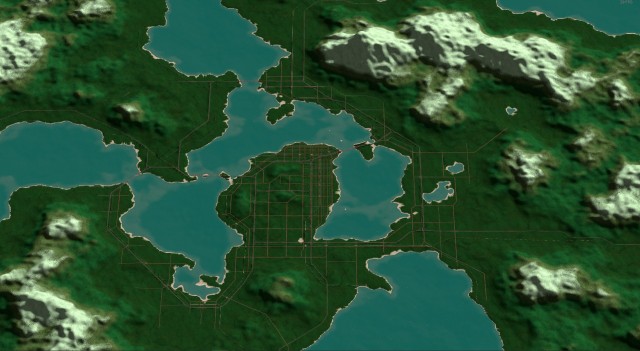
Welcome back to Cityville. Let's start out with some more recent transit maps. Here is Lakeland. And Cityville. The transit system is adequate, but could be better. There is talk of adding some subway lines underneath the busier roads. On a good day, trips by transit come near trips by private car. That's a lot of money. Better demolish some buildings to make way for a graduate school. Oh look, 400k people. The official photographer was on vacation when the milestone was crossed, so this was the picture that ran in the newspaper. It said something about new additions to the university. There's still money left in the budget and lots of demand for residential. The town of Park Place was founded at the entrance to Park Lake. The 20 year plan includes commercial and office developments. Here is a view from somewhere in Lakeland. Let's go back to Cityville, it's more exciting right now. There are some areas near downtown that still need better transit service. Timber Bay has densified but still retains open land outside of the city. A pavilion was built downtown. Here's how the region looks midway through 1980. Thanks for visiting, that's all for now.
-
A small new town was founded one rainy summer between Lakeland and the edge of the world. There's not much to it, and nobody really wants to build their house there. Another small town was made outside Lakeland. Here is the back side of Morcup County. This is a large park that will not be developed, but it did get a rail line and single lane highway built through it recently. A school of engineering was founded. Another milestone in office buildings. When many of Cityville's neighborhoods were first laid out, plots along larger roads were left open for future mixed use or commercial developments. Some areas developed that level of density, while others were allowed to fill in the remaining lots with single family homes. The Park Highway was completed. Lakeland now has much faster access to the farming districts around Buttercup Junction A road and rail were built across the opposite shore of Lakeland, and some new farms popped up. Cityville's skyline is constantly redefining itself. Which house is mine? The mall district. The Timber Bay Highway was extended all the way around the mountain and to the edge of the world. A few new subdivisions were allowed to develop. Time for a satellite view. And a map view.
-
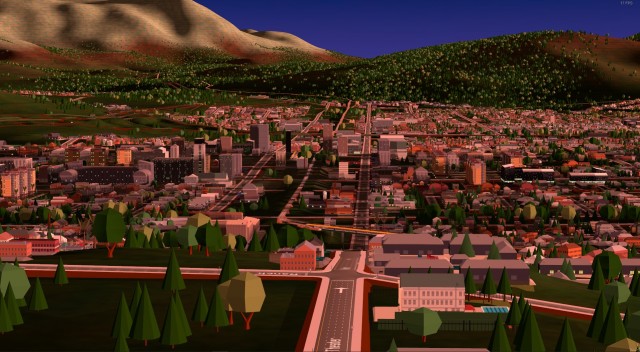
An update came out to NewCity. Among other things, trees can be planted, and there are different types of trees now. New neighborhoods are springing up all around the former forests of Lakeland. Looking across downtown from Cityhill Timber Bay was developing some traffic issues. They were solved by adding another set of ramps from the highway. I messed with the FOV slider for this shot. Mostly I have been playing at 20 degrees FOV, but this shot was taken at 5 degrees. Evening train. A convention center was built across the highway from downtown, not far from the technical college. Only a few homes had to be demolished to make way for it. 50% of the population now has a high school education, and unemployment is reasonable. Cityville is nearly out of unprotected land to develop, but right across the bay sits a large undeveloped area. A feasibility study was done for a highway bridge. A highway bridge will be out of the question for many years. A subway tunnel is possible, but the new area would lack the density at first to make the tunnel worthwhile. After much debate, taxes were raised, and the idea was shelved for the time. That's all for now.
-
From the album City Pictures
-
From the album City Pictures
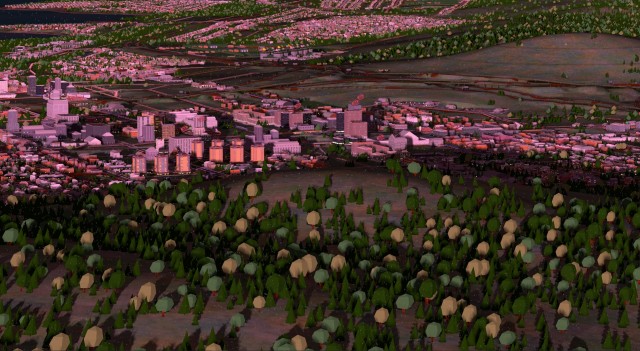
It's not just pine trees in Cityville anymore. -
Here is the growing area around Railroad Lake. Crime is a major problem, so the government focused on adding more clinics. Traffic can get heavy at times during the morning commute. Some fancy new apartments recently opened near downtown. Some money was saved up and a new school was added to Lakeland University. Some of the last flat lands near downtown were recently opened up for residential development. After a construction boom came a hiring boom. Unemployment has dropped as a result. Things are starting to move more quickly in Cityville, one milestone after another. The new art museum was given a location not far from downtown. And for the moment, and unimpeded view of the bay and mountains. Some maps and graphs. The skyline at 300,000 people.
-
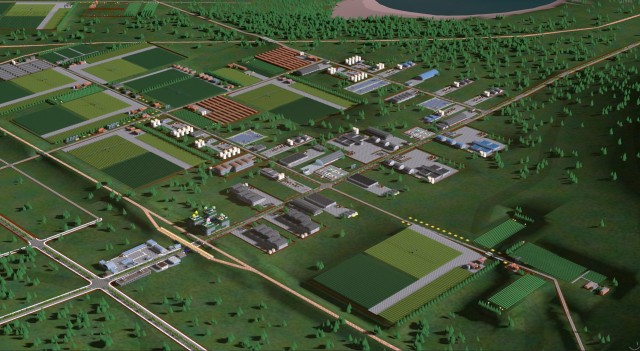
A new neighborhood was laid out between the community college, highway, and a train station. Students frequently complain about the distance between the train stop and their classes. No solution has been proposed yet. Over 40% of people in Morcup County have a high school diploma. That means more factories. Pollution is starting to get bad in the new industrial areas. The Windmill of Knowledge is still Lakeland's tallest structure. Cityville is on the left, Timber Bay on the right. There is still space between the two cities. A committee was recently founded draw up environmentally friendly development plans for the land along the shores. Agriculture is still in great demand in the region. The government recently spend the last of its surplus funds on a rail and highway leading to the edge of the world, on the other side of the lake. There is flat, fertile land for farming, but it is a long commute for the workers. Mixed use zones have existed in Cityville for a number of years, but they have just recently begun developing. 6 large apartment towers were built on the edge of dowtown by an out of town investor. The apartments failed city inspection and had to be demolished before ever being occupied. Federal building Here is the education heatmap. Most of the educational amenities are libraries, with only a few schools. How about some more views of Cityville. Busses and trains were recently changed to a 15 minute interval. Someday it may pay for itself in ridership, but for now, taxes were increased. Lakeland has some polluting factories now too, but they are mostly away from residential areas. Another milestone in residential density. That's all for now. I could use some more names and labels for things in the region, so feel free to suggest names in the comments.
-
From the album City Pictures
-
The medical school still didn't have enough professors to open a proper Phd program 2 years after opening. A town meeting was called about the problem. After much debate, it was decided to allow a Windmill of Knowledge to be built. It's not accredited with any higher education agency, but it does churn out Phds without requiring any prefessors. It's not really a windmill, it's more of a diploma mill. Ok, so I went into the building editor and made a cheap solution to my lack of doctorate degrees. Next time I'll make a better building maybe, and take some pictures of the process. Cityville is finally starting to achieve some density. Just as we thought the lack of doctorate degrees was behind us, a Corporate Headquarters was built, sucking even more educated workers out of the education system. Here's the prosperity heatmap. This town is going to need a lot of public pools... Lakeland is growing. There is much demand for farms, and there is plenty of land on the opposite side of the lake, but the government lacks funds to extend the highways. A community college was founded between the highway loop and Clipper Lake. Even though there was empty land right near the downtown rail station, county planners insisted on bulldozing some old office buildings for the new courthouse. The winter of '68 was a snowy one. A hospital was built this winter too. Looks like we may be seeing another tax hike in the near future. The original elevated rail line passing through one of Cityville's first neighborhoods. An historic district was recently created for the neighborhood. Yep. Property tax went up. Graph time. Timber Bay has grown steadily, but still maintains rural and wild land not far from the town center. Downtown Timber Bay Some new apartments were built in Cityville. There is one pool for adults, and one for kids. Another forest gives way to demand for more houses.
-
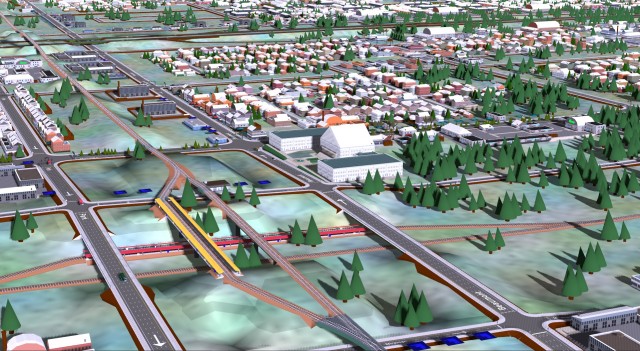
From the album City Pictures
-
Lakeland University got a dorm tower. To help with the crime situation, the school of medicine was chosen to be the founding program. Unfortunately, the few doctors in the region are already in higher paying positions, so the school has yet to hold any classes. The view is pleasant though. Here is a neighborhood in Cityville. Morning above the Clipper Lake bridges. Here is the traffic heatmap. Travel times are long in the region due to distance, not congestion. The transit system continues to expand This unnamed peak across the bay from Cityville has escaped development so far. There is talk of building a bridge or tunnel across the bay, but nobody takes it very seriously at this time. Downtown still has plenty of empty land available. Almost two years after its founding, the school of medicine still cannot attract enough professors to open. More roads were built in the area to give the impression of a functioning town. Residential zones were laid out near campus. The region grows closer to 200,000 people. An unincorporated area at the remote end of Clipper Lake. Let's take another look at the region from afar. We did it. 200,000 people. Funds were raised to build a hospital, but due to the ongoing doctor shortage, construction has yet to begin.
-

From the album City Pictures


