

Ltw
-
Content Count
640 -
Joined
-
Last Visited
About Ltw
-
Rank
Suburbanite

-
-
There are most certainly flaws that could be addressed in a new version. Although, some of these problems could be solved with mods, such like the traffic model (Traffic Manager: President does a great job in addressing that) and the deathwaves could be addressed with a mod as well. And of course a new version in which these issues and issues such as simulation/challenge could be dealt with is the best option. However, I don't know to what extent this is a smart choice from business perspective. The fact that Skylines is so successful is also due to the fact that a lot of casual gamers caught up on the game. I doubt whether they have similar demands as the community. For casual gamers challenge and realism might be more frustrating than exciting. I could imagine that people dislike a game in which they can't really succeed. I really want the problems in terms of realism and challenge fixed (could be in a patch, or in a new game). However, I think there are also big risks involved with releasing a new game which might appeal more to the community but maybe less to casual gamers. Nevertheless, I'm really looking forward to the new DLC and let's hope CO keeps on investing in Skylines!
- 63 Replies
-
- 1
-

-
- skylines
- cities skylines
- (and 2 more)
-

Zone without road driving me nuts
Ltw replied to cantremember's topic in Cities: Skylines General Discussion
I miss the incredible immortality killer of SimCity 4 in this scenario, that always worked out great. Sadly there is no such thing (that I know of) in Skylines. The bug lake as suggested by widox could work quite nicely. Placing a drain-pipe next to the newly created lake should solve the problem quite easily. I have another suggestion that could work. You can download fine road anarchy from the workshop (personally I use No Pillars since I had some compatibility problems with some of my other mods, fine road anarchy has more options though but No Pillars should do the job as well). If you place a road next to/on top of the unzonable area with 'no collision' turned on it should get rid of any growable buildings. I've noticed this with No Pillars, I don't know exactly how fine road anarchy behaves in this matter but it should do a similar job. It is a little bit trial and error though, this problem is fairly uncommon so I don't know if this is a solution but you can always try. And if you have the Disasters DLC you could always hit it with a meteor strike off course -
I agree. Developing a new game is also very expensive. And taking into account that Skylines got a lot of new features with all the DLCs I can't imagine why CO would make a new version. I think for most people the features are more important than graphics, besides, you can alter general appearance a lot with mods, luts, and themes. I think it is more likely that CO would roll out an update in the future which includes some improvements in graphics than that they would develop an entirely new game from scratch. In general I really like the general direction the developers have with Cities: Skylines. The general idea with releasing themed DLCs for around $15,- and including some improvements in a free patch-update is pretty solid. People might not like every DLC but in general the way CO handles updates is pretty good in my opinion. And off course there are still some flaws that need to be discussed. To be honest I don't like every DLC and I still miss some in my opinion essential features. However, CO is also trying to listen to the community and meet their demands. More than most game-developers at least. So maybe we see some of the suggestions made by the community in future DLCs, improving the game further.
- 63 Replies
-
- 1
-
-
- skylines
- cities skylines
- (and 2 more)
-
Most of the vehicles in your traffic jam are for delivering goods. Thus, it is important where to know where they come from and what the destination of those vehicles is. I guess they are from an industrial area in your city and they go to either your commercial zones or an outside connection. Therefore, it is important to make sure this way is the fastest way to get there. If you have other options available you could expand your network over there, dividing the traffic a little bit more. Next to that you can also activate the heavy traffic ban in the district on the right. This way trucks will avoid this area and find another route. If those options don't work and you still have problems in this particular area you can widen some roads and the ramp to your highway. Take a look at Network Extensions if you want to have more options. A good use of roundabouts is to build them on top of the highway. If you build a (preferably large) elevated roundabout which functions as an entry/exit for the highway as well you can decrease congestion even further. If that doesn't work you can also build a new connecting highway with an intersection at this place. That could solve a lot of problems. However, that also depends on the general layout of your city, if there aren't enough zones to build such infrastructure for or if the problems are merely local it is probably not worth it. If you decide to build a highway you can take a look in the workshop for some intersections. There are pretty nice intersections on there as well, and they could also give you some inspiration if you want to build your own. Hopefully, these suggestions could help you out. Good luck!
-
I could help you with this issue I guess! As far as public transportation goes it is in my view important to get (eventually) an extensive subway-network in which people can change lines. You can check the workshop for some good multi-platform stations, practically everything is possible nowadays. Personally, I rely heavily on the subway. However, a mixture of different transportation-types is most feasible. In the beginning, I start with busses. These are quite cheap and are a good way to start public transport in a city. However, there are also downsides, the most important downsides in my opinion are the fact that they only carry 30 passengers and that they are using the road itself, which could reduce congestion a little bit, but will eventually lead to more problems regarding traffic. Hence, the introduction of the subway. The subway is a relatively cheap solution and could carry a lot of passengers. Furthermore you can transfer from line to line quite easily and you can adjust the lines more to your liking by choosing day- and night-lines, and adjusting day- and night budget off course. This is also possible with busses and trams but the fact that they use a depot could lead to some heavy congestion as well. I use other networks as well but I'll get back to that later. First I'm going to elaborate some more on building a subway-network. I often start with one or two subway-lines. I choose a certain point in which I can centralize most subway-traffic. This is mostly Downtown. From this point I build one or two lines to other parts of the city. It is important to keep in mind the destinations citizens want to travel to. These are in general home, work, school, shops, parks and unique buildings. By building a subway-line you want to connect those different destination-types to each other. A subway-line which for instance only covers a residential area would probably not be utilized. Furthermore, I always build a line which goes from one end of the city to the other. Thus, there are two terminus-stations on each line. There are also alternatives like circle-lines but I like this approach better since it is quite straight-forward and it is more flexible as your city expands. A small sidenote is that it is important to think about future expansions as well, if you don't think that through placing new lines could be quite a hassle. Once you've planned out the general direction of your subway-line you can place different stations. In high density areas I place them a few blocks from each other and in lower density areas I often choose to place them at a further distance. Lately, I've also experimented with proper placement regarding noise-pollution. Noise-pollution has quite some effect on health (at least in the latest update). Therefore, I chose to place stations in residential zones strategically next to for instance parks, schools, or offices. At last I (at least in the beginning) don't place subway-lines in industrial zones since those lines aren't used that much. Therefore I stick with residential zones, commercial zones and offices and all the points of interest in those zones. Now that I've laid down the foundation of my subway-network I could work further on different connecting networks. Starting by bus, the bus is the cheapest option and even though it has downsides it is great for those areas in the city in which the subway is just not feasible. I start a bus-line the same way as a subway line. Thus, I choose two sides of the city and I check whether the line is serving the different destinations of citizens. Furthermore, I place different stops next to subway-stations. This way people can easily transfer to subway-lines as well. Bus-connections might not be very lucrative but it is very important to serve the entire city, this way you can easily get high passenger numbers in public transport and thus decrease car-usage. If your bus-line is getting too much passengers leading to congestion and long waiting-times you can consider upgrading to trams. If that doesn't work either you can upgrade to the subway. In both cases it is important to connect lines to a subway-station with several lines, either by placing a stop next to it (like with tram-stops) or by using a dedicated platform in the station itself (with subway). For subway-lines I would recommend getting a dedicated platform for each line, a dedicated platform doesn't cost that much more since multi-platform stations are as expensive (or maybe a little bit more expensive) than standard stations and it makes a huge difference. If financially possible I would also recommend having a dedicated tube for the entire line if you want to use a lot of trains. This is a quite expensive solution but it allows you to increase the number of trains on your line a lot. However, in the beginning I wouldn't worry about that too much. In general it is very beneficial to expand your subway-network a lot if you have sufficient funds. A large network makes people use it more, even if you have some lines with less passengers than you hoped for it helps increasing the number of passengers on busy lines as well. I often have around 15 lines in the end, sometimes more, sometimes less, that mostly depends on the characteristics of the city itself. Furthermore, there are some other transportation options you could consider. I use the subway most, next to the bus and tram. I use the train for outside-connections and long distance connections such as the airport. In general the train station is a central hub in my subway-network. This way I can connect traffic from tourists from outside train-connections and the airport to the extensive subway-network, spreading out the huge amount of tourists over several bus- and metro lines. Next to that the transit DLC gave us some more options. I use the monorail for long distances as well, also for airports. This works pretty nice when you have large custom airports with different terminals. The other transportation types I generally don't use except for the cable cars, but more incidentally, cable cars work nicely when connecting islands or areas which are hard to reach by metro due to the steepness of the ground itself. However, since it is possible that you don't have this DLC I'm not going to elaborate further on this. This is the way I handle public transport. I think I have included everything but it could be that I forgot some things that are important. So just let me know if you're still having some struggles. At last but not least I want to include bikes in this post as well. I use bikes a lot. I often use them after I've established an extensive public transportation network. At this moment I notice that I can't really expand any further on public transport but I'm still having some issues with traffic. I've posted something about bikes and the way I use them in a post years ago. I still do that the same way and it has some great benefits. Therefore I wanted to include that old post as well, you can see it over here:
-
I've started a new city a while ago. The city grew quite rapidly, resulting in a city which was divided by a highway. In my opinion this wasn't a great situation, thus I've changed it. You can see the result below. It used to be like this. However, the area on the left has been developed in urban space entirely. Therefore the highway was a huge barrier (it was also causing a lot of noise in neighborhoods, which I am trying to avoid as much as possible). Like you can see above I've removed the highway, the highway is entirely underground. Above the highway, I've built a big park. This park connects both sides of the city via footpaths and bicycle-bridges. Thus making it more attractive to cycle instead of driving. Furthermore, you can see that there are fewer buses than before. This is mostly caused by the fact that I've increased the number of metro-lines from 4 to 12. Therefore the number of passengers traveling by metro has increased massively. I've also incorporated several large stations in this new metro-system on which you can change lines, leading to a huge increase in passenger numbers as well. I am looking into doing similar projects in other areas in the city. There are still some places with these issues. However, this is kind of expensive and quite difficult to implement because of the big metro system. So I guess these solutions are mostly for the long term.
-
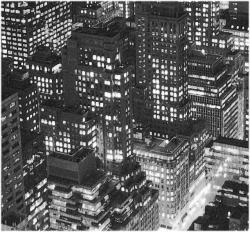
The Empire State Building at night:
-
Have CO lost touch with what players want?
Ltw replied to barcasam7's topic in Cities: Skylines General Discussion
Okay, interesting. I'm sure that there are quite some examples of the importance of cemeteries in urban planning. Death care has been difficult in for instance European cities during the plague-epidemic. However, there are also nice examples of the central role of cemeteries in urban planning, in Arabic cities for instance, you often see very large cemeteries because the Islamic religion is stating that someone should be buried pointing towards Mecca until 'judgment day'. Therefore, you can really see how religious beliefs are shaping the city landscape. Another good example is the function of cemeteries in a lot of South-American countries, the cemeteries over there have a clear recreational function because there often is a lack of public parks. Thus you can see people doing all kinds of recreational activities in those cemeteries, which really broadens the function of such cemetery. My point is that you can really broaden the whole idea of how death care in the simulation should look like since there are a lot of different ideas about the whole concept in real life. However, we should always acknowledge that Cities:Skylines (or a simulation-game in general) is a simulation, and therefore not perfect. And, a simulation will never be perfect, simply because life is too complicated for that. However, it is important to try getting close to perfection. And if (and I know, this is kind of hypothetical since I'm not a programmer) the simulation of death care is making it more complicated for a computer to calculate other things such as wealth, unemployment, and segregating neighborhoods I would rather have that instead since that. FYI, if there is no downside of simulating both death care and wealth, unemployment and segregation that would be preferable. However, I think it is important to keep the discussion going on what is clearly lacking in the game and what could be left out if the game would be too heavy for most computers if you'd include more aspects in the simulation. -
That looks great! What kind of ground textures did you use for the parking lot? It looks very realistic.
-
Have CO lost touch with what players want?
Ltw replied to barcasam7's topic in Cities: Skylines General Discussion
Yeah exactly, that would be a great addition as well. Also stuff like trash on the streets and maybe old asphalt textures if the neighborhood is a little bit rundown could help making it look like it is authentic. I don't know to what extent this is feasible since those details also have to get away or change when the neighborhood is getting more expensive but details like that would be great to look into. Regarding SimCity 2013, that is actually quite detailed in terms of simulation. A lot of things that aren't simulated in Cities:Skylines are actually being simulated in SimCity 2013 by agent-based programming. However, in order to do that they had to choose between size and simulation and they preferred the simulation over the size of the cities, which is in my opinion the wrong choice. However, there are a lot of things that Cities:Skylines should include in the simulation (like I mentioned before) but also things that could've been left out or at least changed. Examples are the hearses, it's unlikely they cause traffic jams and dead bodies being in apartments for days because of traffic jams is simply unrealistic. Furthermore, delivery trucks could be bigger and if you would prefer simulating garbage trucks they should be bigger as well with a wider range. Ambulances should preferably start their trips at depots throughout the city in order to shorten the trip as much as possible. These are some suggestions I have in order to make traffic easier to simulate. I'm not saying I don't like the details in the simulation of traffic but I would rather have the precious computer power being used for something different such as a more realistic development of different neighborhoods. -
Have CO lost touch with what players want?
Ltw replied to barcasam7's topic in Cities: Skylines General Discussion
I agree for the most part with what you're saying. There is a mod which fixes the commuting problem, Rush Hour. This works great and creates a more realistic travel pattern, it also has random events that attract a lot of people to certain unique buildings. However, I would turn off the modified demand, for me that didn't work and resulted in problems (I only had residential demand and no commercial and industrial demand). But if you turn that option off it works great. Regarding the neighborhood-issue that you're raising I totally agree with you. In SimCity 4 you could influence the amount of rich/poor people living in certain neighborhoods by making them more attractive. Neighborhoods with fewer parks, fewer schools and fewer services in general attracted poorer people. Those people applied for certain jobs that fit their profile. They are also more inclined in using public transport. This kind of simulation is seriously lacking in Cities Skylines. In my opinion this should be expanded massively, the basics of the simulation of commute is in general quite decent but I just think that the simulation of income, unemployment, education and so forth is lacking. I think it is quite doable to include this in the simulation. All the information is there, it is just a matter of including this in the simulation. For starters there should be a limit on how well you can educate your citizens. Now it is possible to give almost everyone high education (which is in real life simply impossible). If you could build in a certain maximum (like for instance, at most 25% or 30% is highly educated) you get a more realistic view of how the population should look like. Also, lower educated citizens are only able to live in cheaper neighborhoods, you can keep neighborhoods cheaper by a 'social housing' policy, which is the opposite of the high-tech housing and creates large social housing projects in high density and small terraced houses in low density. Cheaper neighborhoods also attract more crime and people living there are more inclined to use public transport (which is sort of the effect of the free public transport policy, but in this case, you get income from it). Since poorer people (thus, less educated people) are only able to live in cheaper neighborhoods it is actually worth it to build less attractive neighborhoods. If you don't have enough dedicated neighborhoods with lower residential prices a result could be that certain buildings in your more expensive neighborhoods will house more citizens, and also lowering land value around them (an effect similar to the effect of abandoned buildings). You could compare this to a phenomenon in a lot of cities throughout the 20th century, people used to live in bad housing because there was a lack of social housing that could accommodate them (a famous example is Greenwhich Village in New York before it got expensive, but there are also a lot of examples in for instance Brittish cities). These are some ideas I have regarding dealing with neighborhoods and wealth, the best thing is that these suggestions are actually quite doable. The main problem of Cities:Skylines is that agent-based simulation (the behavior of every single citizen is being simulated, which is a different approach than for instance SimCity 4) involves a lot op computer power, giving the programmers some serious limitations in what they can and can't do. However, these suggestions are mostly adding some charactaristics to different agents (thus, citizens). However, the simulation of how they travel and what they do doesn't change too much. Poorer citizens just have more limitations on where they can live, and richer citizens are more inclined in living in more expensive neighborhoods. The limitation of Cities: Skylines is mostly regarding people traveling, however, it can save up to more than a million citizens (which already have characteristics such as place of residence and occupation). So going into more detail on this part could be possible I think. If you really want to do the simulation right it should also include more detailed simulation of education and employment, this could be more challenging since it could influence the agent-based simulation quite drastically in some cases. At first education. Now it doesn't matter how well a citizen is educated, if there is a job below their level they do it anyway and are happy to do that for the rest of their lives. Which isn't realistic in my view, working a job below your level should at least lower happiness, furthermore, it should be a temporary solution, if people are working in a lower educated job for a long time they are more inclined in leaving the city, searching for different work. So if the jobs in your city don't match with the workforce it could happen that the population is decreasing. Furthermore, employment. Now it doesn't matter if you are employed or not. People could be happy without a job for like forever. Therefore unemployment should also affect happiness. Furthermore, rich unemployed people are more likely to leave the city looking for another job and poor unemployed people are more likely to get homeless, they could 'live' in parks (therefore not influencing the agent-based simulation too much), more homeless people could also affect land value and the crime-rate. There could be a policy for this offering free shelter for homeless people, which costs a lot but could solve a lot of problems. I think the suggestions I've just raised could really improve the liveliness of cities. It gives the player more challenges in managing a city, normally the challenge is mostly traffic but I want to do more. Including stuff like this in the game could really improve the experience in my opinion. CO could do this by for instance releasing a new DLC focused on social housing. The free content included with that could be the revised simulation. I think I would rather have such a DLC in the future than a DLC that is focused on one small part of the game that I didn't really miss in the first place (such as the public transport DLC, snowfall, stadiums, and those creator packs). Most DLCs could also be covered by some of the great content in the Workshop, but I think that a Housing DLC is something that could really add more value to the game. -
A square Downtown:
-
I do have education boost turned on, so that could have some effect on the employment as well. However, I would be surprised if this policy would have such a huge impact. Cims are also working at jobs below their level if there is nothing available so that shouldn't be a big issue. I could run the simulation without this policy though, and see what happens. Edit: I turned off the education boost in order to make sure that people are more inclined to work and I've looked around if there were any mods that might have influenced demand. I don't have any demand-mods but I do have the Rush Hour mod. Apparently there is a fixed demand option in there which calculates demand in a different way, the options for Rush Hour state that the demands are linked together and commercial, industrial and office demand is based off of populated residential buildings, residential demand is linked to the number of empty workplaces. I had quite some empty workplaces before which probably caused the high residential demand, why this didn't result into a high commercial demand is a mystery to me. However, I've turned off this demand-option and since then my residential demand declined to zero and my industrial demand increased to medium-high. So now I'm building industrial zones and offices in order to increase the number of jobs. This did however result in some massive commercial abandonment, but I think this should decline when I have more industry which could provide these zones with goods. The unemployment declined from 64% to 58% in a short time and I expect it to decline further. However, progress is slowly. Thus, it might take a while until the problem is solved and the commercial abandonment is solved as well.
-
I have a weird issue in my city. You can see the issue in the picture below: As you can see in the picture above my unemployment is very high. 61% is an unemployment-rate I haven't seen before in any of my cities. However, the demand doesn't portray a good picture either. Residential demand is very high and commercial and industrial demand is fairly low or non-existent (this commercial demand is the highest I've seen for quite some time actually). In that case when I'm building according to the demand my unemployment should rise even more since there are more people that can't find jobs. I've seen the same issue in the city I was working on before this one, in that city the unemployment peaked at 42%. The strange thing is that I don't do anything different than normally, I build in order to satisfy the demand (but not too much). When I do that I am actually facilitating in this high unemployment-rate. In general that doesn't really matter since unemployment doesn't have any negative effects (some of the shortcomings in simulation, but that's another topic). However, I would prefer to be able to build more commercial zones and industry. Do you have any idea what could cause this issue and how to solve this? That would be of great help!
