



Hexagonal Grids

As soon as the Eldians explored the world beyond the walls, they set their sights to the next frontier: the expanse beyond the atmosphere. In the decades of peace following the demise of the titans, thunder spears almost fell out of use, if not for a science fiction author's fantastical writings - about worlds of ice crusts concealing salty oceans, moons of fiery lava, and planets of sand dunes - that were inspired by their grandfather's book.
Subsequent advances in thunder spear technology led to rockets, suborbital and orbital flights, and deep-space missions. The early unmanned rocket launches using essentially upscaled thunder spears were wildly successful and further boosted public enthusiasm for ever more ambitious missions. But since thunder spears were not exactly designed to be recoverable, the de-orbiting of early manned missions resulted in several crew capsules tragically burning up and exploding during descent via atmospheric re-entry.
Nevertheless, the astronauts draw courage and resolve from the legendary Scout Regiment of old, and successfully petitioned to rename the space center in honor of the eccentric Survey Corps commander who spearheaded the development of rocket science. To this day, crewed spaceflights are traditionally designated as numbered "Exterior Scouting Missions".

"With sorrow and decision in our hearts, we show the will to move on."
- Commemorative Plaque at Mission Control, Hange Zoe Space Center
National Historic and Cultural Landmarks:
- Hange Zoe Space Center
- Langnar Main Library
- Zacharius Meat Auction
- Gelgar Distillery
- Carla's Diner
- Arlert Donuts & Coffee
- Ackerman Memorial Orphanage
- Ymir Fritz Police Academy
The End
 While trying to come up with creative ways to use up the virtually infinite industrial demand, I stumbled upon the hexagonal pattern that I felt looked "futuristic" and appropriate for the spaceport I placed on the easternmost tip of the island. That prompted me to ask the question that city planners from nearly a century ago also asked themselves: could hexagonal urban grids work?
I actually started with the bigger hexagon pattern covering ~3 large cities because industrial zones are far easier to place for reasons I've described in previous entries; I only did the smaller hexagonal neighborhood a little to the south much later because the diagonal/non-grid residential/commercial spaces are a pain to layout, although the hotkeys help somewhat.
At first glance the hexagonal grids with 3-way intersections do appear to perform better than the conventional rectangular/square grids with 4-way intersections, but I can't definitively say because I hadn't developed the hexagonal areas enough to bring them to a high enough traffic volume for a fair comparison with the rectangular/square neighborhoods. Either way, the one big thing the conventional rectangular/square grids have going for them is that they are so much simpler to lay out: for the hexagonal neighborhoods I had to painstakingly count and measure road segments for hours, in contrast for the rectangular/square grids I could lay straight roads all the way across the map to form the grid layout within minutes.
The hexagons are not really regular hexagons but still I was pleasantly surprised with how well they fit. In some screencaps further below, it starts off with a normal four-way junction as a "seed", with the hexagons fanning outward from it kinda like a snowflake.
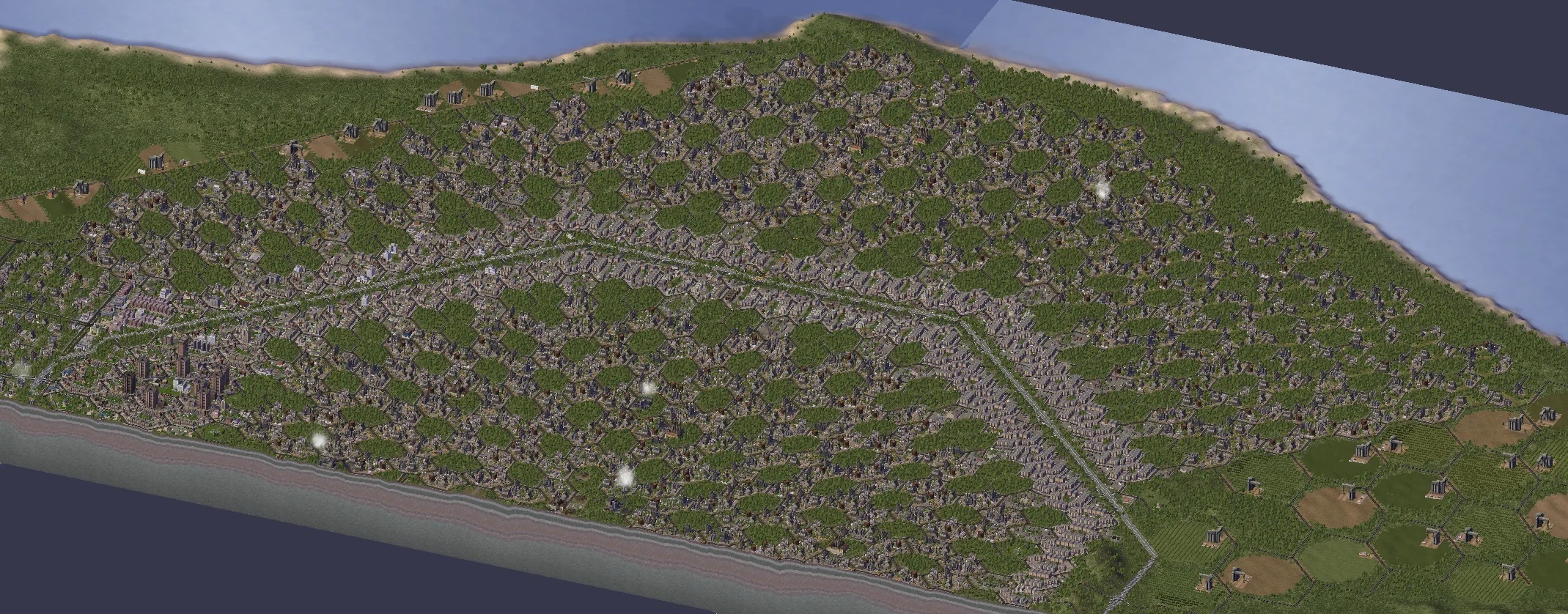


Another criticism levied at hexagonal grids is how would it approach street naming and addressing? For rectangular grids it's literally straightforward: you just need the street name and lot/building number. For hexagonal grids I imagine instead of locations being anchored to street names, they would designate a certain center block or blocks, then number each hex block radially around it, either clockwise or counterclockwise. Then the lots/building numbers within each block would also be assigned radially in a similar orientation. They could get away with nameless streets - instead of street signs they could have signs displaying the block numbers at regular intervals on each side of the streets and at each 3-way junction. Still might be disorienting because the travelers could lose their sense of the cardinal directions (NSEW)


-
 6
6


3 Comments
Recommended Comments
Sign In or register to comment...
To comment in reply, you must be a community member
Sign In
Already have an account? Sign in here.
Sign In NowCreate an Account
Sign up to join our friendly community. It's easy!
Register a New Account