


First Steps


For centuries, the Kingdom of Elomere was dominated by an entrenched nobility and powerful church leaders. The royal family ruled from the central island in the lake of Elomere. However over time powerful dukes assumed most of the day-to-day governance over the surrounding lands.

The old Royal Palace was dominated by a large church. Crown and Faith where closely interconnected in these old days.
Citizens of several towns slowly demanded more autonomy. Everything changed, when the grand flood struck. The royal palace fell victim to the disaster and was washed away by the water. The last queen, Ilina III. was never seen again. The old order collapsed in the next years.
While the Dukes tried to maintain order, many towns declared themselves to be “Free Cities”. A civil war ravaged the land. Each duke and each town raised their own militia.
To defend themselves and to create a better future, several towns joined together and formed the Egalitarian Community. They dreamed of a common republic with common ownership of the means of production.
But not all towns joined. Several majors feared, that they would loose their independence in such a union. Some wealthy citizens where concerned about a collectivized economy. This lead to several autonomous city-states who defended their sovereignty at all costs.
The territory of the aristocrats was now split into several domains. With the passing of time, they realized, that a reconquest of the whole kingdom was now impossible. But the Egalitarian Statists failed to subdue the autonomous towns.
Due to exhaustion these fractions agreed to an armistice, focusing now on rebuilding their own communities. Some autonomist communities allowed the Egalitarian Statists to use key roads to connect their territory in return for guarantees of their independence.

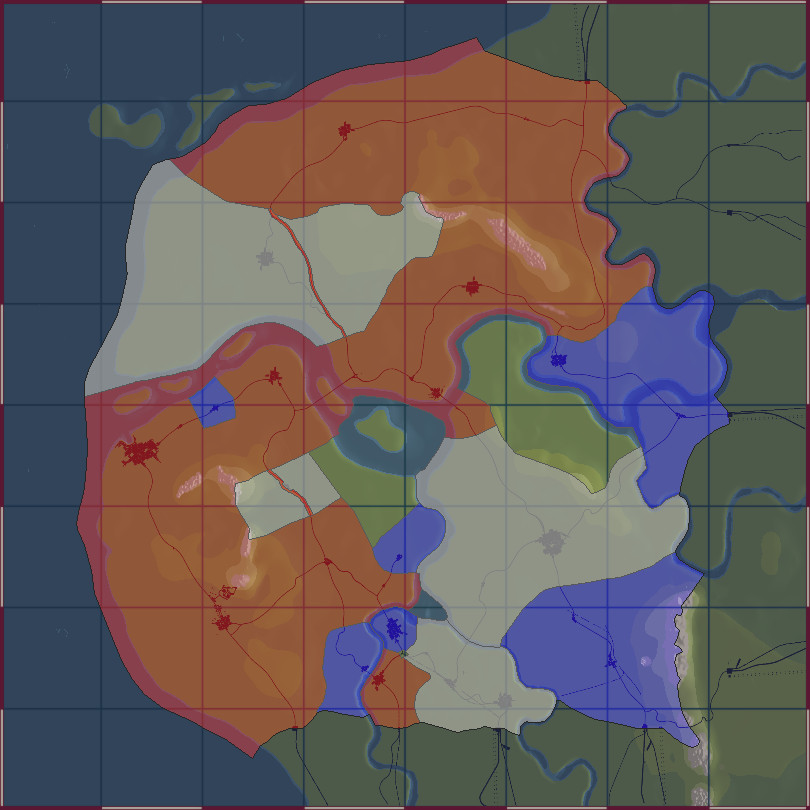
Red is the territory of the Egalitarian Statists, Blue are aristocratic remnants, white-grey is the territory of the Autonomists
Fractions and Ideologies

3 Ideologies already control most of the map. After the fall of the kingdom towns and villages fell under their control.
Aristocrats (blue, fleur de lis)
Aristocrats see themselves as the guardians of tradition. Usually they govern from their castles, palaces, monasteries or cathedrals. They prefer small to medium density buildings. They tend to give patronage to the arts by building museums, art galleries and opera houses. Their areas are highly hierarchical principalities dominated by protocols, titles and traditions. Each territory has their own ruler
Egalitarian Statists (Red, three arrows)
Egalitarian Statists prefer a strong state and large economic networks enabling a high standard of living. They want to create a large democratic state with a contiguous territory. Egalitarian Statists prefer a society without poverty or rich elites. Usually large parts of the economy are administrated by the state. They prefer medium to high density development.
Autonomists (grey, black fist)
Autonomists reject being part of a larger nation. Independent towns and villages are the ideal form of organization. They want to preserve their independence at all costs. Economic self-sufficiency is more important than large scale production. They prefer low to medium density. Each local community has their own structure and traditions.
3 Ideologies could appear later in the journal. To appear, they first have to establish new settlements.
Libertarians (yellow, torch)
Libertarians reject state governance; in their view an unshackled economy is necessary for human development. Their society is dominated by large corporations. They live in free trade zones with multiple companies or in company towns dominated by a single enterprise. Libertarians prefer medium to high density buildings, except for low density mansions for corporate elites. Their cities are hubs of heavy industry and modern entertainment.
Futurists (green, microchip)
Futurists want to embrace the future. They want zones of control free from traditions. Technocratic leadership should plan and implement new projects to create a better, faster and more productive society. They prefer small towns with a high density. Futurists want to live with all amenities of modern life. Open-minded, they embrace contact with other groups around them. Futurists are very enthusiastic about space travel.
Outlander (brown, bow)
Outlander live outside of larger settlements, either as nomads or in small villages, outposts and block houses. They have no central organization.
Dawn of a new era? - Building the town of "Solidarity"
After the end of the civil war, delegates of the Egalitarian Community gathered in the town of Engelberg. They developed ideas and visions how to develop a strong economy.
However many people doubted that their grand visions could become reality. The economy was based on simple subsistence, small farms and artisans. The main method of transportation was still the horse carriage. And the entire country lacked electricity. Their territory was split, and only the transit roads allowed basic transport without crossing borders.
Instead of modernizing all towns simultaneously and crash the economy and spend all limited funds, the delegates decided to create the prototype town of tomorrow.
A special development district was formed under the direct control of the government. This district should later become the town of Solidarity.
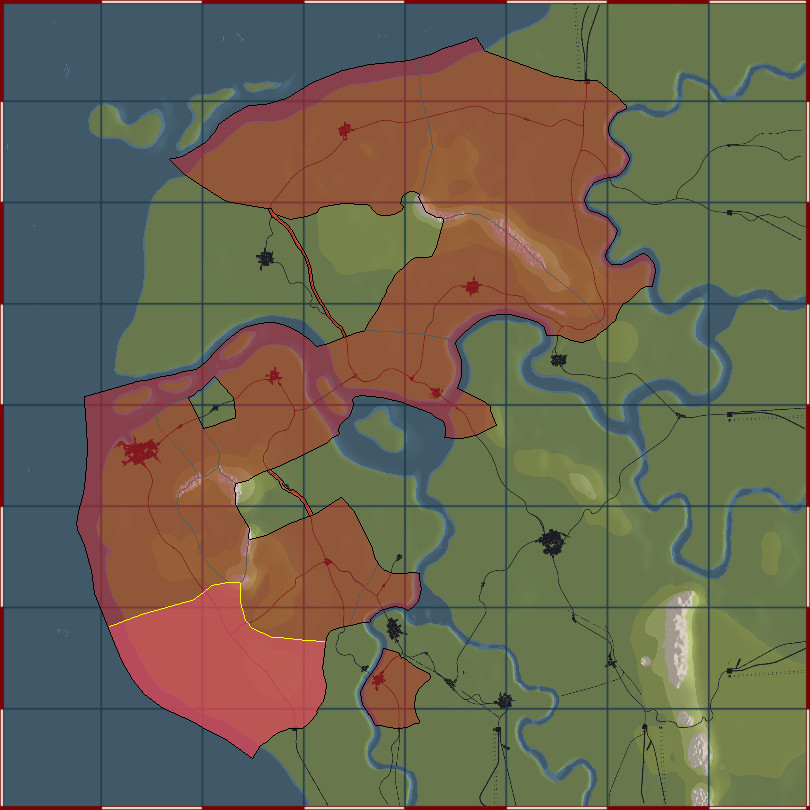
Municipalities of the Egalitarian Community, including the special district of "Solidarity" in the South
The first step for a modern economy was the construction of a coal power plant, a coal refinery and a coal mine. A regular bus line should connect these essential industries to the nearby town of Solidarity.

Everything had to be imported from abroad ...
The town was rather small but with most essential services. A large bus station became the center of the town. Public transit was integral to the planning and construction of "Solidarity". Private Car ownership was entirely absent.

To modernize agriculture and produce some domestic consumer goods, a large modern cow stable and a slaughterhouse where build close to the power plant. This was the first step away from subsistence farming.

But the future path for development was still uncertain. The council of the Egalitarian Community was split between supporters of consumer good production and heavy industry. They had to develop further industries to earn export revenue while increasing the standard of living.
How would the Aristocrats react? Would they also begin to industrialize?
Will the independent towns choose their own paths of development or become dependent from others?
Would new ideas arise and challenge the status quo?
Only the future could tell.

Dreams of a better future?
Science and education was horrifyingly neglected under the old kingdom. But a small community of hobby astronomers emerged. And some of them dreamed big. Could they reach the stars? Could they build rockets and see the planet from above?
Several Space Enthusiasts and Astronomers gathered in the Astronomic Society. To prove the possibility of space travel, they build the low-budget R-1 rocket. This sub-orbital rocket gathered some basic data. Instruments where rather primitive. The R-1 had a magnetometer, a black and white camera, a simple barometer and a thermometer.
The R-1 reached the edge of space, a huge success. But the Astronomic Society lacked the resources for future space travel. The towns had to invest in space travel and scientific infrastructure before further space exploration could became a reality.

The base map is "Perbatalia" from Roves on the Steam Workshop https://steamcommunity.com/sharedfiles/filedetails/?id=2291032615&searchtext=perbatalia
Thank you for the map!
Thank you to all Workers & Ressources modders and the game developers!
-
 8
8


4 Comments
Recommended Comments
Sign In or register to comment...
To comment in reply, you must be a community member
Sign In
Already have an account? Sign in here.
Sign In NowCreate an Account
Sign up to join our friendly community. It's easy!
Register a New Account