



Chapter 3: The First Year

The settlers at Arthur's Cove had survived the first Winter, which fortunately had been quite mild with only a dusting of snow during the coldest nights. With the arrival of Spring, the fields along Deer Creek were in full production and the first calves and lambs had been born.


New pens were constructed to separate the herds, as a precautionary measure to avoid the spread of diseases, and new timber dwellings were constructed to house the shepherds just to the North of Arthur's Cove, at Shepheard's Bay.


It was not only the livestock that were breeding; for the settlement had grown by six over the Spring months, with several more children expected over the coming months. Although a joyous occasion, resentment and jealousy was starting to become apparent between those men that had a partner, and those that did not. For the first six months, the settlers had been so busy trying to establish themselves that they had little time for anything else. However, as the settlement became more self-sufficient and the settlers had grown into their new roles, the lack of single women was becoming a major concern. With slim chance of a friendly vessel discovering their settlement any time soon, and even slimmer chance of women from such a vessel joining the group, Arthur proposed a number of community-building activities to keep the settlers busy. One of the first of these was to construct a church in the centre of town, St George's Chapel, to shift the focus and maintain morality amongst the men. The community-building activities would keep the settlers busy for now, however for the settlement to survive into the future, many more women would need to join.

As stockpiles of food continued to grow through the Spring and Summer months, a storehouse was constructed to store the excess. The trail between the farms along Deer Creek and the storehouse became a well-trodden path with horse-drawn carts, having been constructed by some of the carpenters to assist in transporting the farming produce, making the journey twice a day during the peak production season. The storehouse was brimming with fresh produce and the settlers enjoyed a healthy diet of potato, radishes, carrots, lettuces, spinach and beans, in addition to the occasional beef, mutton and venison.

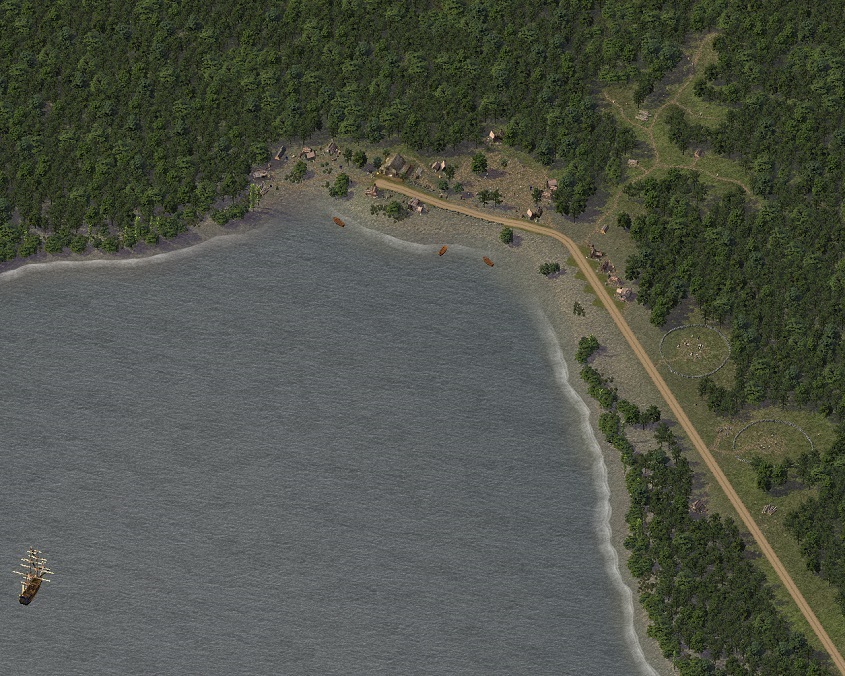
However, as Summer came to an end, heavy rains battered Arthur's Cove. After several weeks of constant rain, some of the food in the storehouse was beginning to show signs of mold and rot. Unfortunately for the settlers, a good portion of their hard work over the past few months had come to nothing, as a majority of the stock needed to be discarded. Fearing a lack of food supplies for the coming Winter, an alternative source of food was required to supplement the farming produce. The smaller coves and bays around Charlotte's Bay were brimming with fish during the warmer months as they seeked shelter to breed, and the greater bay area would no doubt be abundant with fish stocks to supply the settlement for generations to come. Many of the sailors who had been working aboard the "Charlotte" were quite competent fishermen and very familiar with ship construction and maintenance. With their experience, work began on a new fisher's camp near the mouth of Arthur's Cove, where a small wooden dock and storehouse was constructed. Several small fishing vessels were also built by the sailors, and the first fishing expedition set off to seek out the best fishing grounds in the bay.

The end of Summer '89 also co-incided with the first anniversary of the founding of Arthur's Cove. As had been agreed at the initial meeting of the party, an annual review of the settlement would take place, to be chaired jointly by Arthur and William, where each member would be given an opportunity to voice their thoughts, opinions and concerns, as well as to vote on new laws, upcoming community projects, and the leadership of the settlement for the following year. The first vote amongst the group was for the retention of Arthur Portsman as Commander of Arthur's Cove, which was unanimously agreed. The second vote, also unanimously agreed, was for William Buck to remain as Deputy Commander. Although satisfied with the leadership, the different groups of settlers did however want more ability to discuss their specific needs and requests directly to Arthur and William throughout the year, as opposed to waiting for the annual meeting. It was therefore agreed that a form of representative government be established, which would meet on a monthly basis to provide expert advice and community feedback to Arthur and William on important issues. Four main community groups were identified, which would each elect a member to represent the group to serve for the following year. The following members were selected to form the first government:
- Joseph Billings - Farmers, Shepheards & Hunters
- John Stonewell - Carpenters, Masons, Tailors & Blacksmiths
- Stewart Greyham - Fishers & Sailors
- Ernest Bourkeham - Church, Families, Women & Children

The last agenda item, and the most hotly contested, was for a name to be given to the new land. Several options were put forward, and four were selected for a vote - Freeland, Arthursland, New Britain, and New Southland. After an initial vote, Freeland and New Southland were the two clear favourites. A second and final vote was held between the two options, and ultimately the name New Southland came out on top. The settlers would call themselves New Southlanders and agreed the settlement at Arthur's Cove would become the Captial of the new nation, to be named Port Arthur.

-
 16
16
-
 1
1


0 Comments
Recommended Comments
There are no comments to display.
Sign In or register to comment...
To comment in reply, you must be a community member
Sign In
Already have an account? Sign in here.
Sign In NowCreate an Account
Sign up to join our friendly community. It's easy!
Register a New Account