


A brief history

Harbourtown (actually "The Royal City of Harbourtown") was first mentioned at around 100 BC by the Roman General Quintus Aurelius as Portus Cavere. The small village was an important military base during the Roman Empire. Despite it's military significance it soon became an important port of transshipment for goods from all over the world. The number of inhabitants soon began to rise as people from the surrounding villages came to the town to find work at the docks or as a trader. Some decades later, the romans were gone, the town was renamed as Harbourtown.
At 1702, the Queen of this beautiful country visited the town on a summer trip. She was so amazed by the large forests around the town that she decided to build a summer residence outside the city. At this point the town was suddently in every newspaper and gained publicity everywhere. Rich townspeople started to settle around the residence to have something in common with the Queen and to show off their wealthyness. Soon middle class and less well off people moved aswell into the city to get some luxury for themselves and on the hope to find work. Once they were there the industry followed and so Harbourtown had a little industrial revolution for itself and soon became the heart of the regional and national industry.
In 1730, the Cathedral was finished and the Queen renamed the town again in "City of Harbourtown" which is what it's still called today. More religions tried to build churches for themselves in the city and the old roman temples were in the way. A lot of them were demolished and just a few roman buildings remained in the inner city. The major religions soon became Catholicism and Evangelism which, even now, causes regular collision between these two partys. By that time, also the new trainstation was build which is still the terminal station for numerous National and International railway lines.
Today the city is well known for the exclusive architecture of it's churches and the inner city. The remaining roman temples are still attracting tourists from all over the world into the city and the lare pedestrian zone is famous for its diversity which still remains people of the old days. But the once so proud industry is slowely decreasing and beeing pushed ou of the city boundaries by commercial highrises and the larger growing suburbs. The habour also starts to get abandoned since the trade by ship isn't used as much anymore. The lower class gets problems finding jobs and the city can't only rely upon banks, especially since the credit crunch. Unemployment rises and crime levels are up by 30%.
How will the city encounter this problem?
But for now, some impressions of the city.

An small section of the harbour today with the heavy industry.

And here is what already happend to a large part of the harbour complex. On the right is the new quarter "Richmond", and on the left the developing commerical disrtict, also known as "Wheat Dock". At the bottom is the remaining industry.

The Residence with it's old walls. The quarter inside the walls is called "Queens Park" with the royal cemetary, the Conservatory which houses a number of very rare roses and orchids. Also here you can see two churches whereby the brown is the oldest chuch in the city. On the left is the another quater, "Freeman". This one is very popular under the rich inhabitants and tourists, and not only because of it's red brick roads.
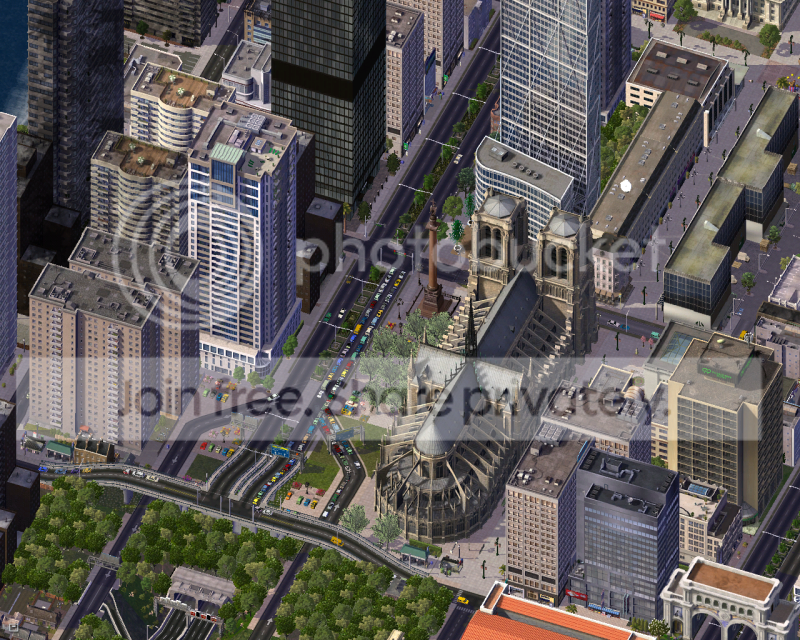
The old, catholic, Cathedral ("Church of our Lady") with the Pedestrian zone at the top and the St. Barbara Column. At the left you can see the regularly congested "James-Hetfield-Square" and underneath it, the entry of the "Cross-City-Tunnel" in the "Sara-Phillips-Memorial-Park". This is a good example of what often happens in Harbourtown: Skyscrapers next to historical buildings.
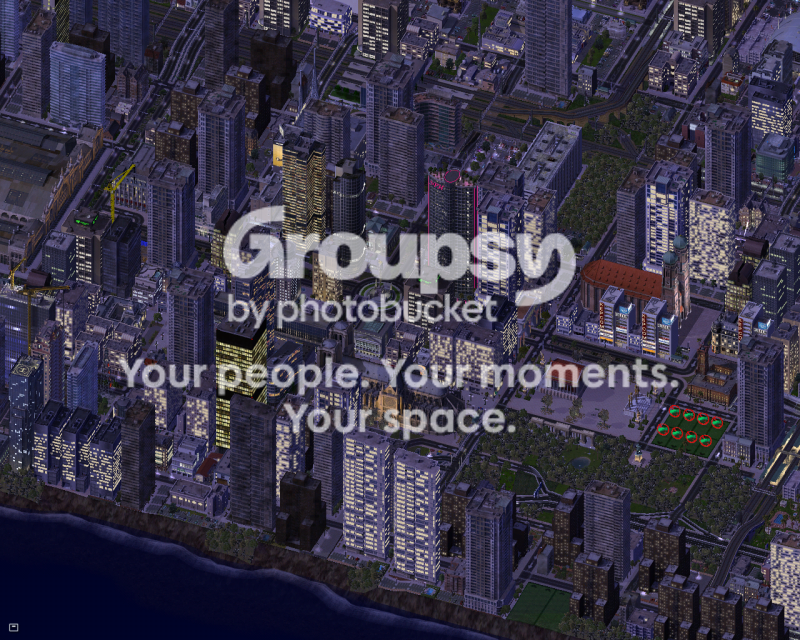
This is an overview of "Central & Waterfront". You can see the Cathedral, the roman temple of Mars and the "Benz Plaza", the old City Hall, now the Ministry of Education and at the far right the second largest, church "St. Michael", evangelic. The "Grand Station" is located at the far left and at the very top is "Aylestone Station".

And here is one of the last ramining heavy industries. "Montag Oil Company", the second largest Oil producer nationwide.
That's it for now. Gonna work on my photo technique for the next entry (like No Grids, No Symbols, etc...). Hope you enjoyed it so far. Leave comments, positive as well as critique, happy about everything really.
Coming up:
- A map of the metro and suburban train network
- Pics of the city in total
- Pics of the historical parts of the city
- & more, more, more...


9 Comments
Recommended Comments
Sign In or register to comment...
To comment in reply, you must be a community member
Sign In
Already have an account? Sign in here.
Sign In NowCreate an Account
Sign up to join our friendly community. It's easy!
Register a New Account